Tuesday, November 4, 2008

New Sahale Snacks Review

Some of you may remember my recent review of the Valdosta Pecans by Sahale Snacks. As it turns out, a rep at Sahale noticed my review and thought I might be interested in a "preview" of their upcoming line. I of course jumped at the chance to be sent free food, with one condition: you may send me free food, but I cannot be bought. If I don't like them, I'm going to say so and why. Since they were okay with that, they sent some snacks on over.

The new line is a collection of glazed nuts: two different kinds of almonds and one kind of cashews. We have Almond PB&J with peanuts and berries, Almonds with cranberries, honey and sea salt, and finally, Cashews with pomegranate and vanilla.

I was a little worried. It's no secret that I'm about the only person in the world who isn't allergic to almonds, and still doesn't like them. Well, not whole, at least. But when I started munching on the PB&J almonds, I felt myself starting to convert. In fact, I think I actually liked the whole almonds in this better than I liked the peanuts in it. These nuts are not glazed as heavily as most glazed nuts; just enough sugar to make it sweet, but not too much. The berries in question are dried strawberries and dried raspberries, but they certainly don't taste like dried fruit. The pieces of fruit are tiny, almost as if grated, but that doesn't take away from them. All in all, I was thoroughly impressed with this mix.

Next up were the cranberry almonds. They failed to mention in the title that these also contain sesame seeds, but they are there and they are welcome. They don't take over in terms of flavor, but I think they help provide a nice balance. Speaking of balance, this mix is a little more heavily glazed than the first, but the sea salt helps balance it out. The orange blossom honey is a little light to me, but that also means that there is none of that bitter aftertaste that honey usually has. The cranberry pieces aren't as tiny as the fruit in the PB&J, but they are still smaller than you may be used to. It's a good mix, but I don't know that I'll be buying a whole lot more of it. If I'd tried it first, I don't think it would have converted me to liking whole almonds.

Last but not least were the cashews. These are just... awesome. Seriously, I'm in heaven. The fruit pieces are smallish, and I honestly do wish there were a few more of them. The sweetness was dead on perfect, and greatly complimented by the addition of vanilla. In fact, it's strange, but the vanilla is very obviously there, but it's not incredibly obvious that it is in fact vanilla. When I let friends and coworkers try it, they all wondered what the flavor was, and when they found out, the response was invariable something to the effect of, "ah, of course. Man, that tastes good!" This is all an excellent sign. Cashews are a favorite of mine, but I still usually can't eat very many at once; they're just too rich. But these, I think I could go on forever eating them. Not only are these my favorite out of the glazed nut mixes, they might even knock Valdosta Pecans out of the running as my favorite Sahale Snack of all.

Now, the bad news: did I mention these were a preview? It is my understanding that they are to be released sometime this month, but at the time of this writing, the website still says "Click Here To Be Notified When Glazed Nuts Are Available In Stores". Hey, you think you're disappointed. I feel like a crack addict now, unable to refill my stash. I think now that I've tasted these awesome snacks, the wait will be even worse for me.

When they are available, run, don't walk to the nearest store that sells them and buy yourself a case. Consider it emergency food storage, for any unforeseen famines than may come your way. Food storage that you rotate on a very regular basis. You know, to keep it fresh.

Sunday, November 2, 2008

Importing the USDA SR21 into MySQL

If you're planning on using the USDA Standard Reference in your own software, it helps to have it in a format that your program can actually read. If you're in Windows, this isn't an issue, since the database is available for download in MS Access format. For other platforms, an ASCII version of the database is also available.

The format of the files is pretty easy to deal with; each file is caret-delimited, and text fields are surrounded by tildes. The documentation explains pretty clearly how the tables are laid out. It's simple to put together an SQL file that defines the tables, but it's tedious. And then you have to write a script to parse the data.

I just did those things this morning, and I thought I'd share, to save you the trouble. The SQL is in MySQL format, and the parser is written in Perl. I know that not everybody likes those two things, so if anybody wants to convert my SQL to Oracle (shudder) or PostgreSQL format, I'll be happy to post it. The same goes for converting the Perl script to Ruby (/me waves to Hans) or Python (/me waves to Matt) or to some other language.

import_sr21.pl - Perl script
sr21.sql - MySQL Format

Friday, October 31, 2008

Composite Recipe: Banana Bread


Back when I baked for a living, I formed a theory that the only difference between different quickbreads is the type of pulp used (well, and spices). At the time my brain seemed to think that there was a world of different types of quickbreads, and it held onto that believe until I decided to actually try and prove or disprove it.

The idea was, I would create composite recipes for five different types of quickbreads, and then create a composite recipe based on the composite recipes. The first was easy: pumpkin bread. Banana bread (below) was next. Then I thought I'd try zucchini bread. Then I thought I'd try... um... what was another kind of quick bread? Wasn't there... um. Well, there was... er... gee, what other quickbreads are there?

It was time to hit Google. After a few searches, I had found recipes for pear bread (but oddly, no apple bread) and for Boston brown bread. The pear bread recipes seemed pretty close to the pumpkin, banana and zucchini bread recipes. The brown bread recipes seemed fond of cornmeal, which takes them out of my quickbread theory. Everything else still seems (at a glance) to fit, though I obviously haven't finished my comparisons yet.

The banana bread recipe that I came up with did seem really close to the pumpkin bread recipe. Take a look:

IngredientsRecipe 1Recipe 2Recipe 3Recipe 4Recipe 5Recipe 6Me
oven temp350F350F350F350F325F325F350F
bake time1 hr60 – 65 min45 – 60 min55 – 60 min50 – 60 min1 hr 10 min50 – 60 min
ap flour3 cups4 cups2 1/4 cups3 1/2 cups1 1/4 cups4 cups3 1/2 cups
ww pastry flour    1 cup  
baking soda2 tsp2 tsp2 tsp1/2 tsp1 tsp2 tsp2 tsp
baking powder   2 tsp4 tsp2 tsp2 tsp
salt1/4 tsp1/2 tsp1 tsp1/2 tsp1 tsp2 tsp1 tsp
cinnamon  2 tsp2 tsp1 tsp2 tsp2 tsp
cloves  1 tsp   1 tsp
nutmeg  1 tsp   1 tsp
bananas6 – 8 ea2 1/3 cups6 ea6 ea (3 cups)5 ea6 ea6 ea
butter2/3 cup1 cup 1 cup1 cup1 cup1 cup
shortening  1 cup    
sugar1 1/2 – 2 cups 2 cups1 1/2 cups1 cup2 cups1 1/2 cups
brown sugar 1 1/2 cup     
eggs2 ea4 ea4 ea4 ea4 ea4 ea4 ea
vanilla2 tsp  2 tsp2 tsp 2 tsp
milk     2 Tbsp 
nuts  1 cup2 cups   
banana garnish   1 lg banana   
methodmuffin (kind of)creaming (kind of)creamingmuffinmuffincreamingmuffin

Again, any recipes that were not already for 2 loaves were converted. I looked at mixing methods again this time, and was surprised to find that some recipes used a creaming method instead of a muffin method. Interesting that that didn't happen with the pumpkin bread. But not surprisingly, some of the mixing methods varied enough that I had a hard categorizing them. Welcome to the Internet.

The thing that kind of threw me was the flour. I ended up with 3 1/2 cups instead of 3 cups. I thought about just using 3 cups, which would put it more in line with my pumpkin bread, but I thought I'd keep myself honest and leave it at what seemed like a reasonable comparison with just the other banana breads.

Rather than mushing up the bananas, I got lazy and tossed them in the food processor. That just about liquified them, but it did give me an even consistency that the pumpkin puree had, and that mashed up bananas wouldn't have. The bananas seemed more liquid than the pumpkin, so I thought that maybe the extra 1/2 cup of flour really was accurate. But in the end, that didn't seem to be the case. Still-warm-from-the-oven slices of banana bread were okay, but once it cooled it just seemed a little dry to me. I don't know that dropping all the way to 3 cups is right, but maybe 3 1/4 cups would be more appropriate.

Speaking of liquid, this recipe had something the pumpkin bread didn't: vanilla extract. In retrospect, I think that while it would be a compatible flavor with both, it works far better with banana. And did you notice how the first recipe calls for more bananas, but fewer eggs? Maybe not a bad way to introduce extra flavor, without throwing off the moisture ratio.

The other major difference between these two recipes is leavening. Baking soda vs baking powder. As per the recipes, I went with just soda on the pumpkin bread, but both in the banana bread. Part of me wants to look up acidity values for pumpkin vs banana and do some maths, but the part of me that's too lazy to do so has so far been much more convincing.

Spices varied a little, but not much. By and large it seemed that most people were only interested in cinnamon, but a couple added cloves and nutmeg. I kind of liked the idea of adding those two extras, so I went with them. After tasting the batter, I thought that I might want to halve the amount of clove, but I didn't really pick up the nutmeg. But I think something might have been lost without it. It just had that extra non-cinnamon spiciness that my my tasters this time around (I brought a loaf to class to share with my students) seemed to enjoy. They especially loved the clove however, which was somewhat subdued after the baking.

It was interesting to note the garnishes that people came up with. One person went with a lot of nuts, as well as dried banana chips. For my part, I went with semisweet chocolate chips. My tasters really dug those. A couple of people said they provided a really nice balance.

A final thought on this recipe. While the bananas were added in mostly as mush, not all of them got cut up completely. There were a couple of chunks, and when I hit them, they added extra flavor and moistness to the bite. This tells me that either I should go with mashed, rather than pureed bananas, or I should drop the flour and/or add more banana to it. I'm voting for dropping the flour, but I might try mashed next time around.

Thursday, October 30, 2008

Implementation Recipes

What do I mean by implementation recipes? Well, you may recall my initial post on composite recipes. That's a recipe that I build based upon other existing recipes. It has the benefit of stealing other peoples' work, while still forming that work into something that I can call my own. That sounds a lot like rationalized theft, doesn't it? Let me ask you: You know that prized tomato sauce recipe that you're so proud of? Are you really going to claim that you invented tomato sauce? Or are you going to admit that you're just standing on a lot of other peoples' shoulders, just like I am?

Okay, with that out of the way, let's talk about implementation recipes. Part of the idea is to take a recipe and turn it into a concept. What is lasagna? Alternating layers of noodles, tomato sauce and cheese. Lasagna may contain other components, but those components (or sometimes variations on them) remain at the base foundation.

The problem is, just knowing what defines a lasagna does not actually help you make a lasagna. That's where my implementation recipes come in. Once you know what defines a recipe at its most basic level, you can build a recipe that achieves the purpose, but little else. It is just a basic set of ingredients and instructions effectively becomes a proof of concept, without having much personality of its own. You could make that recipe and be content with it, but don't expect to be winning any contests anytime soon.

That is what I mean by implementation recipe. This is the most barebones recipe that you can put together, just waiting to be tweaked and hacked and modified by other cooks. Part of my goal with my composite recipes is to learn about the recipe itself, and another part is to take my observations and build them into implementation recipes. Then when an implementation recipe has been created, it can be made available along with suggestions for the cook's own personal improvements. And that is where the cook him or herself can really shine and make that recipe their own.

I'm planning to put together a few of these recipes myself. This is why you've been seeing so many composite recipes from me lately. I've started with bakery recipes because they're extremely formulaic, and very easy to derive my own recipes from. Right now I'm working on a composite recipe for turducken, and it's proven to be a great deal more difficult. But once I have a few of these recipes under my belt (literally and figuratively), I'm hoping to make them available elsewhere on my site in a non-blog-type format. Maybe even as samples for the vaporware Open Recipe Format.

Thursday, October 23, 2008

It's Over

No, I'm not talking about the tragedy of Mother's Cookies going out of business, though that did make me unbelievably sad.

I'm actually talking about the French Laundry at Home blog. I heard about this blog sometime last year, and have been reading it regularly since early this year. It would seem that I missed most of the fun and excitement, though I was happy to read along as Carol finally prepared her last recipe: Cornets. I was surprised that she saved this one for last, since I think that that's the first recipe that I (and a lot of other people who have either purchased The French Laundry Cookbook or have been so lucky to have dined at The French Laundry) think of when I think of either the book or the restaurant. But I like her reasoning. When I read the recipe I thought, "I bet I could do that without too many problems." When she read it she apparently thought, "I'm not going to do this one without making sure I can do it justice." And it seems that she has.

Carol seems to have posted her last post at that blog, but there is good news. She's decided to attack another cookbook: Alinea.

Grant Achatz, the owner/chef of Alinea, served as sous chef to Thomas Keller, owner/chef of The French Laundry, for a few years. I think that as a lot of people (including myself) watched Achatz move up in the cooking world, they started to wish that he would put out a book. When I found out about the book, oh, 6 months or so ago, I don't think 5 minutes had passed before the pre-order site had my credit card number on file.

About a week or two ago, I started reading posts from bloggers who had already gotten their copy. I grew increasingly jealous and worried with each passing day that my copy did not arrive. On Monday, it came. But as a testament to how busy this week has been, I only got to look through maybe a quarter of it before flying out to Pittsburgh for a couple of days. I don't know how many recipes I'll be able to get through; I'm unfortunately fresh out of ingredients like methyl cellulose. But I'll do what I can.

Those of you that are interested in new frontiers of cooking, now's a good time to check out the Alinea at Home blog. It looks like it'll be starting up next week. I know I'm looking forward to it.

Monday, October 20, 2008

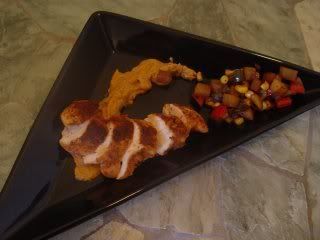
Pumpkin + Chicken


This is what happens when I start pretending that I have any sort of avante garde plating skills or recipe ideas. Actually, this one wasn't so bad, but I'm still almost embarrassed to share it. But I'm sharing it anyway.

I asked three people this evening a simple question: "pumpkin + chicken. Thoughts?" Two of them informed me that it didn't sound like such a hot idea to them. One of them responded with, "umm... fajitas?" Clearly, he wasn't opposed to the idea.

Why were the other two so resistant to the idea? Okay, let me give you a partial phrase and have you fill in the blanks. Pumpkin... pie, right? Or pumpkin bread. And that's pretty much it. It's a shame, really. Have we forgotten that pumpkin is a squash? Squash is almost always cooked as a savory dish, not sweet. So keeping that in mind, let me ask you: pumpkin + chicken. Thoughts?

For the past few weeks, I've had part of a dish in my mind. It involves a smear of some kind of pumpkin sauce on the plate, with chile-rubbed chicken on top of it. Unfortunately, that's not much of a dish. It needs something else. So I thought I'd give it a try this evening.

For my pumpkin sauce, I went with pretty much equal parts pumpkin puree and coconut milk. I spiked it with some chipotle powder, and then added some "pumpkin pie spices" that I've used before in savory dishes: ginger and allspice. I think I might have added a touch of cinnamon too, but I've also had that in savory dishes (mostly Greek). The resulting sauce was kind of like a spicy, liquid pumpkin pie. Not quite what I was after. It was also a little thick. More coconut milk next time. In fact, thinking about this in retrospect, I kept thinking about Thai flavors that might go well. Maybe a touch of soy sauce, a splash of fish sauce, and probably a dab of curry paste. That might work well.

The chicken was prepared my favorite way: rubbed with olive oil and chile powder and sauteed. Actually, lately I've been using this cajun blend that a buddy of mine picked up for me from the House of Blues in Chicago. Very garlicky, very good. I sauteed it, added a couple of splashes of Worcestershire sauce, and when it looked like the outside was getting too hot while the inside wasn't done yet, I added some chicken stock to the pan to cool things down a little and intensify the flavors. When the liquid was evaporated, I removed the chicken and let it rest.

I wiped the pan clean with a paper towel and added diced pumpkin, both red and green bell peppers and some corn to some more oil, and kicked up the heat. I seasoned with salt, pepper, more chile powder and after it picked up some color, some Worcestershire sauce. It was just a basic veg medley, and that really was the problem. It was boring. The pumpkin tasted just like another squash.

I plated up anyway, and it was a decent dish. I really need to work on my plate design, but it wasn't too bad. The chicken was seasoned and cooked perfectly. Believe it or not, it actually worked really well with the pumpkin sauce, but I still felt it tasted a little sweet, despite the lack of sugar. The veggies, as I said, were boring. They were greatly improved by getting some pumpkin sauce on them as well, and that's bad. They should have been able to stand on their own.

Thoughts in retrospect: the pumpkin sauce really needed to be more savory. Something in the neighborhood of panang curry might work really well. And to compliment that, I think cooking the chicken kai yang style would be really appropriate. But then we're back to the veggies.

My first thought went like this: pour all the veggies in a Pyrex dish. Add olive oil, balsamic vinegar, bacon, and give it some time in the oven getting all caramelized and good. Then pull it out and serve it with a sprinkle of feta. Now that would be good. And it also would have little to no relation to the Thai flavors in the rest of the dish.

I haven't decided yet what to do with the veg. And I'm ever conscious of the fact that this dish included no starch. Also, I need to find different plates. I love the black triangles, but they're just not big enough for an entree. Better suited for dessert. Kind of ironic, since that's what America seems to think of pumpkin as well.

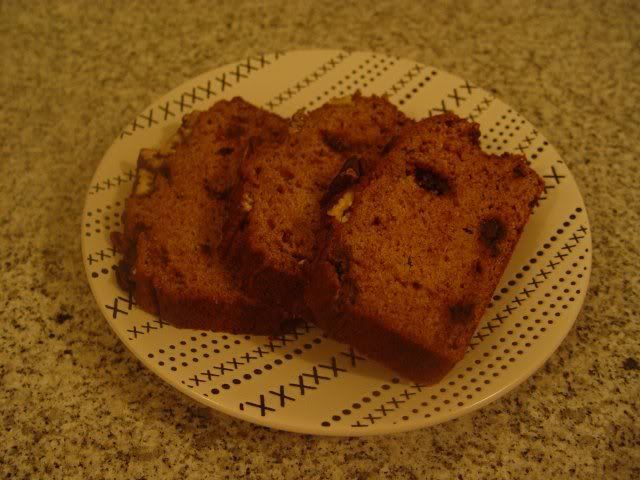
Composite Recipe: Pumpkin Bread


I played around with another composite recipe over the weekend: pumpkin bread. You might have guessed if you read my blog around this time two years ago that I love pumpkin. I even have some IQF diced pumpkin in my freezer right now. But since I was spending so much time comparing recipes (you believe me, right?), I got lazy and used canned pumpkin puree. That means that it's okay for you to too.

First, the ingredients:

IngredientsRecipe 1Recipe 2Recipe 3Recipe 4Recipe 5Me
oven temp350 F350 F350 F350 F350 F350 F
bake time50 – 60 min1 hr 10 min1 hr50 – 60 min1 – 1 1/4 hrs1 hr
ap flour3 cups3 cups3 1/2 cups3 cups3 1/3 cup3 cups
salt1 tsp1/2 tsp1 1/2 tsp1 tsp1 1/2 tsp1 tsp
baking soda2 tsp1 tsp2 tsp2 tsp2 tsp2 tsp
baking powder 1/2 tsp  2 tsp 
sugar2 cups3 cups3 cups2 cups3 cups2 cups
pumpkin puree2 cups16 oz16 oz2 cups2 cups2 cups
olive oil1 cup     
vegetable oil 1 cup1 cup1 cup1 cup1 cup
eggs4 ea3 ea4 ea4 ea4 ea4 ea
water1/2 cup 2/3 cup1/2 cup  
nutmeg1 tsp1 tsp2 tsp1/2 tsp1 tsp1 tsp
cinnamon1 tsp1 tsp2 tsp2 tsp1 tsp1 tsp
allspice1 tsp  1/2 tsp1/8 tsp1/4 tsp
cloves 1 tsp 1/2 tsp 1/4 tsp
mace    1/8 tsp 
ginger    1/4 tsp1/4 tsp
nuts1 cup1 cup1 cup1 cup1 cup1 cup + 1/2 cup
mixing methodmuffinmuffinmuffinmuffinmuffinmuffin

Note: Not all of the recipes yielded the same amount. Some were for one loaf, some for two. For ease of comparison, I have scale all recipes to yield two loaves. If you just want one, cut it in half.

This was an interesting recipe. The oven temps were the same across the board, and I can't say the bake times were all that different either. Flour, also largely the same. Salt, the same. Baking soda only deviated when baking powder was introduced into the picture.

And that's where I started wondering: which would be better? Baking soda or baking powder? Perhaps both? The baking soda, being a base, needs some sort of acid in order to actually produce any gas to provide lift. Baking powder has both a base and an acid, so it only needs moisture to activate. And bonus, I've found it near-impossible lately to find baking powder in the store that isn't double-acting. Double-acting baking powder adds a second lift when it meets the heat, which would add just a little extra lift in the oven.

Does pumpkin bread need all that much lift? It gets plenty from steam. How much acid is in pumpkin, anyway? I don't know. I kind of wonder if it actually does me any good to provide any sort of leaveners in the first place. Maybe I'll check it out... eventually.

I found it interesting that sugar was always at either 2 or 3 cups. Clearly, it didn't matter a whole lot, so I went with 2. The third cup adds sweetness that isn't needed, and when scaled for a commercial kitchen would just add extra cost for little to no benefit. America may be used to overly-sweet confections, but I prefer balance. Maybe with future batches, I'll be able to get it down to a cup and a half or less.

I found it interesting that the first recipe called for olive oil instead of veggie oil. This is also a recipe that calls for you to make your own pumpkin puree. I'm sure it was designed to be some sort of high-quality, better-than-sex pumpkin bread, but hey! I'm gonna feed this stuff to my kid! With any luck, it'll be a good couple of decades before she starts making that kind of comparison. Besides, olive oil is going to detract from the star of this dish: pumpkin. So I stick with veggie oil. (Irony: the recipe comes from some chick named Elise, which also happens to be my daughter's name.)

Eggs. Same across the board. Are we noticing a pattern here? But interestingly, the eggs apparently didn't add enough moisture for some people, so some recipes added water. I don't believe that water is going to bring anything to the table, either in terms of flavor or physics, so it stays out. It would probably just add to the cooking time anyway.

The place where each recipe really differed was in the spice arena. People have some very different feelings as to what constitutes a pumpkin spice blend. Everyone used nutmeg cinnamon, but that's where the similarities end. Allspice, cloves, mace and ginger all make appearances. The only one that I left out of my recipe was mace. I just don't have enough experience with it... yet. That will need to change.

You'll notice that while everyone else called for 1 cup of nuts, I call for that plus another half a cup. This is because when I actually baked for a living, we had a rule: no quickbread left the oven without some kind of garnish. This usually meant muffins, but pumpkin bread, banana bread, that kind of crowd also got something sprinkled on top. Usually nuts. In addition to adding a little something extra, it also gives the diner a clue as to what is actually in the confection. But I have a confession: while I did sprinkle pecans on top, I didn't stir any in. I chopped up a couple of discs of Mexican chocolate and stirred that in instead.

For those of you not familiar with it, Mexican chocolate is not the same as the chocolate that you're probably used to. It is not silky-smooth; it is gritty. It has maybe just a little too much granulated sugar in it, and is spiked with a bit of cinnamon. Most people I know only use it to make hot chocolate. I thought it might be complimentary to the pumpkin bread.

Okay, so I looked at the mixing instructions briefly on these recipes. Everything was more or less a muffin method, which is normal for quick breads. The procedure is easy: mix together all of the dry ingredients (not including sugar) in one bowl, mix together all of the wet ingredients (which includes sugar) in another bowl, then mix together the two bowls.

I think that other than the questionable spices, my recipe is a pretty basic implementation recipe. It will give you a basic pumpkin bread recipe that is easily adaptable to your needs. Other than the Mexican chocolate (which proved to be too sweet with the larger chunks), the sweetness balance was pretty much perfect. I'm going to have to spend some more time with pumpkin spices, but I thought the mix that I went with was pretty decent. Feel free to adapt it to your own liking.